
We Live Inside an Engineered Attention Economy
Through the logic of the attention economy, AI will either save us or destroy us.

This is the second post of a six-part series of essays informed by field notes and reflections written during a period of rest and transition after completing my M.A. in Bioethics.
The attention economy is shaping how we think. I’ve alluded to this before, but it deserves its own space.
At the beginning of the pandemic in 2020, I read Digital Minimalism by Cal Newport. It was the first time the attention economy was explained to me in depth.
The premise is simple: We should use technology intentionally rather than letting it shape our values. If we’re not mindful, we risk quietly outsourcing our priorities to systems designed to capture and hold us.
That philosophy runs counter to the logic of the attention economy.
So what is the attention economy exactly?
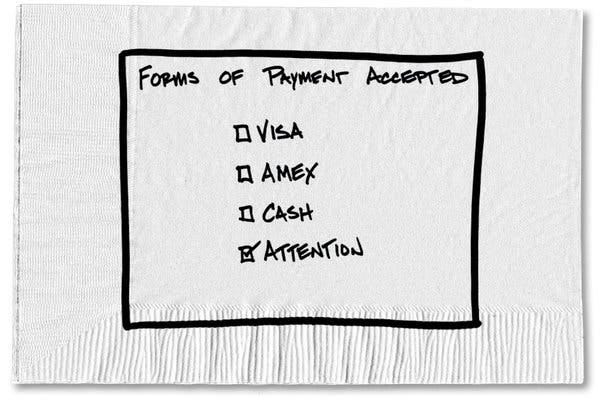
At its simplest, it’s an economy where human attention is the primary commodity.
Companies profit when we look. They profit more when we keep looking.
Marketing campaigns are engineered to interrupt. Privately funded media outlets lean into sensationalism to keep us refreshing stories as they unfold rather than reading them once they’ve unfolded. Influencers curate aspirational lifestyles that feel real enough to trust, polished enough to sell.
The goal isn’t just visibility.
It’s retention.
But aren’t we educated enough to prevent what Newport warns us about?
There are many debates about how well critical thinking skills develop in the American education system. Still, most of us were taught to recognize logical fallacies:
Ad Hominem: Attack the person, not the argument
Straw Man: Misrepresent the opposing view
False Dilemma: Present only two options
Hasty Generalization: Draw big conclusions from small samples
Slippery Slope: Predict extreme outcomes from minor steps
Appeal to Pity or Popularity: Use emotion or the crowd instead of reasoning
And yet, these are precisely the devices that sustain attention.
Why?
Because outrage spreads faster than nuance.
Certainty feels better than complexity.
Stories of conflict travel further than stories of restraint.
The attention economy does not reward careful thinking.
It rewards reaction. Especially intense reaction.
And intense reactions are cognitively expensive. They consume energy that could otherwise be used for reflection, discernment, and complexity. When we’re emotionally activated, our capacity for critical thought narrows.
In American politics and in media coverage of emerging technologies, extreme cases dominate. Nuance gets flattened.
Through the logic of the attention economy, AI will either save us or destroy us. Those are the only two “acceptable” headlines.
But reality is rarely headline-sized.
So what do we do?
We can’t opt out entirely. Nor should we.
The answer isn’t withdrawal. And it isn’t emotional repression.
It’s cultivation.
Cultivating:
Slower conversations
Space to emotionally process and digest. Emotions matter.
Media diets aligned with our values
Intellectual humility, especially when stories are still unfolding
Spaces where disagreement doesn’t equal threat
Resisting the attention economy isn’t about having perfect discipline. It’s about reclaiming authorship over what shapes your mind.
Because attention is not just a cognitive resource.
It is a moral one.
What we attend to shapes what we believe.
What we believe shapes how we act.
And how we act shapes the kind of world we co-create.
If AI is going to transform society, the deeper question isn’t whether it will save us or destroy us.
It’s whether we can sustain the kind of attention required to engage it wisely.
That’s the work.
Not panic.
Not utopianism.
But disciplined, value-aligned attention.
Excellent work!